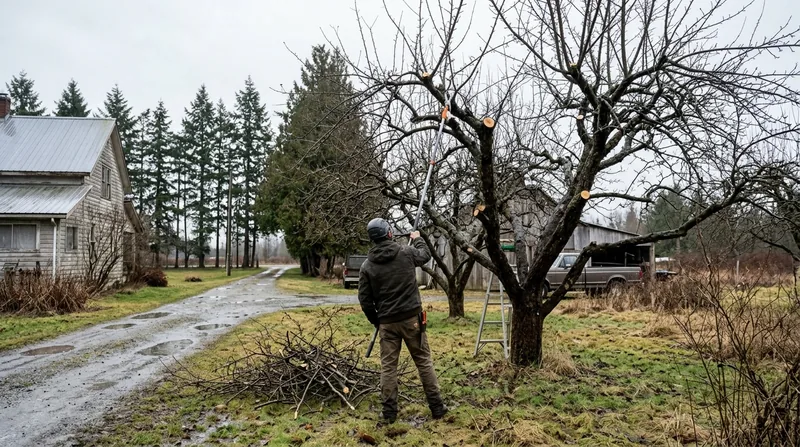




Fruit trees in Abbotsford carry a lot of weight. The valley's wet spring pushes rapid growth, and a mature apple or pear tree left unpruned for two or three seasons turns into a dense, shaded canopy where fungal problems settle in. Fruit tree pruning in Abbotsford is the work of opening that canopy in late winter, before buds break, so air moves through the branches and the tree can carry a crop without splitting under its own weight. Our ISA Certified Arborists have worked the orchards and backyards of the Abbotsford area since 2012, from the old farm properties in Bradner-Mt. Lehman to the smaller residential lots in Townline. We prune apple, pear, plum, cherry and fig trees with the structure of the tree in mind, not just the view from the kitchen window. A free estimate is available at our contact page.
Why fruit trees need structural pruning in this climate
The Lower Mainland gives fruit trees a long, damp growing season, and that is exactly the problem. New shoots extend fast, the canopy thickens, and the centre of the tree stays wet for hours after rain. Apple scab, powdery mildew and canker find easy footing in that kind of shade. A tree that has never been structurally pruned also carries fruit on weak, crowded limbs that tear away in a windstorm.
- We remove crossing and rubbing limbs that open wounds and invite infection.
- We thin the interior so sunlight reaches the fruiting wood and air dries the leaves.
- We shorten heavy scaffolds before they load up with fruit and split.
- We clear dead, diseased and broken wood that harbours pests through the winter.
Done properly, structural pruning adds years to a backyard tree and makes the harvest easier to reach from the ground.
Key fact: In a wet year, a neglected apple tree in Bradner-Mt. Lehman can put on more than 60 centimetres of new shoot growth in one season. That growth shades the fruiting spurs, and the fruit that does set stays small. A single late-winter pruning pass resets the balance.
How our crews prune a fruit tree
We start with the tree, not with the saw. An ISA Certified Arborist walks the property, identifies the species and rootstock where it can be read, checks the trunk for canker or old damage, and decides what the tree can afford to lose in one visit. Old, overgrown trees are usually brought back over two or three seasons rather than cut hard all at once.
- We inspect the tree and note dead wood, included bark, cankers and any active bird nest before work begins.
- We make the large structural cuts first, removing competing leaders and low limbs that block access.
- We thin the interior with clean, angled cuts at the branch collar so the tree seals the wound.
- We shape the outer canopy to keep height manageable for picking and spraying.
- We chip the prunings on site or leave the wood for firewood, whichever the homeowner prefers.
Every cut is made with a sharp, clean tool, and we do not leave stubs or flush cuts that slow the tree's natural defence. Homeowners who want the full picture of what pruning involves can read our tree pruning service page.
Key fact: A mature plum in Townline with a canopy roughly 5 metres across typically takes two arborists about three hours to prune properly, including clean-up. The same tree cut badly in summer can lose a full season of fruiting wood.
Pruning methods we use on fruit trees
Not every tree needs the same treatment. The method depends on species, age, the rootstock and how the tree has been managed before. We choose the approach that fits the tree in front of us.
| Method | Description | Context |
|---|---|---|
| Structural pruning | Selects and spaces the main limbs to build a strong framework. | Young to mature apple, pear and plum trees. |
| Canopy thinning | Removes crowded interior growth to improve light and airflow. | Dense trees showing mildew or scab. |
| Renovation pruning | Brings an overgrown or neglected tree back over several seasons. | Old backyard trees left unpruned for years. |
| Deadwood removal | Cuts out dead, broken and diseased limbs. | Any fruit tree after storm damage or a hard winter. |
| Restorative pruning | Reduces height and spread on trees that outgrew their space. | Trees crowding a fence line or roofline. |
Matching the method to the tree is what separates a pruning job that lasts from one that has to be redone next year.
Timing and the rules that apply around Abbotsford
The best window for structural pruning is dormancy, from late fall to late winter, while the tree is bare and the wood is easy to read. Spring and early summer work happens in some cases, but we check for active bird nests first, because nests are protected under provincial law. The City of Abbotsford may require a permit for a private tree removal, often with replacement planting as a condition, and an arborist report normally supports that application. Rules differ from one municipality to the next across the surrounding area, so we confirm what applies before any removal is scheduled. Where a fruit tree sits near the private electrical service entrance, our crews keep to the required approach distances; anything touching the public distribution network is referred to BC Hydro.
Residues leave the site the same day. Prunings go through the chipper and the chips can stay for garden use, and larger wood can be cut to length for firewood. Homeowners who want to keep the wood can arrange that with the crew lead on site, and our brush chipping page explains how that side of the job works. For properties that need a broader clean-up, deadwood removal covers the larger limbs and storm-hung branches.
What we look for on a fruit tree call-out
Every visit starts with a short assessment, and the findings shape the quote. A backyard tree in West Abbotsford rarely presents the same issues as an old orchard tree on a larger property, and the plan reflects that.
- We check the graft union and lower trunk for canker, borers and old mechanical damage.
- We look for included bark where two limbs meet, a common failure point on plum and cherry.
- We assess the root flare and note any soil settling or water pooling from the valley's clay.
- We note the surrounding structures, fences and service drops that limit how the tree can be shaped.
These notes are shared with the homeowner before work starts, so there are no surprises on the invoice. If the tree is beyond saving, we say so and point to tree removal rather than selling pruning that will not help.
Book fruit tree pruning in the Abbotsford area
Late winter books up quickly, and the best slots go to homeowners who call early. Our crews cover Abbotsford and the surrounding municipalities, and we bring the same standard to a single backyard apple tree as to a row of orchard trees. Call (236) 602-5164 to arrange a free estimate, or check the pricing page for a sense of what a typical job involves. If you are comparing companies, ask about insurance and about who actually makes the cuts; our ISA Certified Arborists are on staff, and our crews are covered by liability insurance with a certificate available on request.
Prices Fruit Tree Pruning in Abbotsford — Indicative pricing
| Service | Price | Details |
|---|---|---|
| Young fruit tree, structural pruning | From $175 | Trees up to about 4 metres, single visit, clean-up included |
| Mature fruit tree, full pruning | From $325 | Apple, pear, plum or cherry, canopy up to 7 metres |
| Renovation pruning, overgrown tree | From $475 | Neglected tree brought back over one or more seasons |
| Orchard row, multiple trees | From $95 per tree | Five trees or more on the same property |
| Chip and haul away prunings | From $85 | Chipping on site, chips can stay for garden use |
| Free estimate | Free | On-site assessment, reply within 24 hours at (236) 602-5164 |
Indicative prices; free, personalized estimate within 24h at (236) 602-5164.