



When a mature western redcedar starts browning from the top down, or a big-leaf maple shows thinning crown growth through the summer, the problem is rarely obvious from the ground. Tree disease treatment in Abbotsford starts with identifying what is actually stressing the tree, whether that is a root rot in heavy clay, a canker on the main stem, or drought damage carried over from a hot, dry summer. Our ISA Certified Arborists have worked on properties across the Abbotsford area since 2012, and we diagnose the cause before we recommend a treatment. We serve homeowners, strata councils, and acreage owners from Townline to Bradner-Mt. Lehman. If you are comparing companies, start with a written arborist report so you have a clear record of the diagnosis.
Why tree disease treatment matters on Fraser Valley properties
The Lower Mainland's wet winters and dry summers create two opposite stress patterns in the same yard. Western redcedar, the tall yard tree and long clipped hedge of choice across the region, thins from the top down after repeated dry summers, while western hemlock on the slopes and red alder on wet ground show root and stem problems that only become visible once a tree is already in decline. Catching the problem early is the difference between a treatment plan and a removal.
- We confirm whether the issue is infectious (canker, root rot) or environmental (drought, drainage, soil compaction) before writing any prescription.
- We map the tree's root zone and check the soil profile, because in Abbotsford and the surrounding area clay holds water in winter and bakes hard in summer.
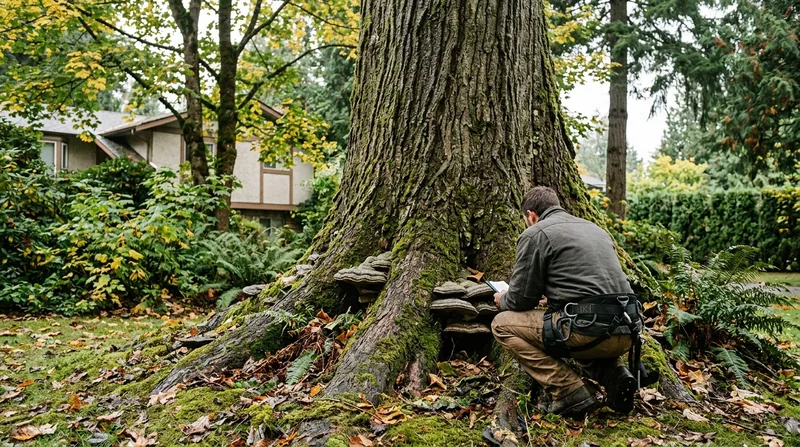
- We look for bark damage, fungal fruiting bodies, and crown dieback patterns that point to a specific pathogen rather than general decline.
- We check neighbouring trees of the same species, since a single sick cedar usually means the hedge or the row is next.
By the end of the assessment you know what the tree has, how far it has progressed, and which options are realistic.
Key info: A 2021 heat dome follow-up on a Townline property found that 60 per cent of a 30-metre western redcedar hedge had lost its top growth within two seasons. Deep watering through July and August, plus a light structural prune in dormancy, brought the hedge back to a workable screen without removal.
For provincial guidance on tree health and pest reporting, the BC Ministry of Forests forest health page is a useful reference for common pathogens in this region.
How our arborists diagnose and treat sick trees
Diagnosis is a process, not a single visit. We start at the base and work up, because most of the problems we see in the Abbotsford area begin underground in saturated clay or in a root flare that has been buried by landscaping fill. The steps below apply to residential lots, strata common areas, and small acreages alike.
- We walk the property and record the species, age class, and crown condition of every affected tree.
- We expose the root flare on suspect trees and probe the soil to check drainage and compaction.
- We sample bark, foliage, or fruiting bodies where a pathogen is suspected and send them for lab confirmation when needed.
- We write a treatment plan that separates what can be treated from what should be removed to protect the remaining trees.
- We schedule follow-up visits in the correct season, since dormant-season pruning and summer watering follow different calendars.
Every plan ends with a written summary you can keep with the property records, which also supports a future permit application if removal becomes necessary.
Key info: On a ravine lot near West Abbotsford, a mossy big-leaf maple with crown dieback was saved by removing two competing stems and clearing the root flare of 15 centimetres of dumped soil. The tree was reassessed 14 months later and had recovered full leaf coverage on the retained structure.
Treatment methods we use
No single method fits every diagnosis. The table below shows the main approaches we apply in this region and the situations where each one makes sense. We choose based on species, site conditions, and how far the decline has progressed.
| Method | Description | Context |
|---|---|---|
| Root flare excavation | Removing excess soil and mulch from the base to expose the root crown. | Buried root flares on landscaped lots and strata properties. |
| Structural pruning | Removing dead, crossing, and weak limbs to reduce stress and improve airflow. | Dormant-season work on Douglas-fir and big-leaf maple. |
| Deep watering program | Slow, deep irrigation through dry spells to support stressed cedars. | Western redcedar hedges and yard trees after hot summers. |
| Canker and deadwood removal | Cutting out infected tissue and sterilizing tools between cuts. | Ornamental cherry and other susceptible ornamentals. |
| Soil improvement | Aerating compacted clay and adding organic matter to improve drainage. | Lowland flats and new-build lots with disturbed soil. |
Each method is paired with a monitoring interval so you can see whether the tree is responding before committing to a larger scope.
What regulates this work in Abbotsford
Tree disease treatment itself is not a permitted activity, but the work often sits next to decisions that are regulated. The City of Abbotsford may require a permit for a private tree removal, and the application is normally supported by an arborist report, so our diagnosis and written summary feed directly into that process when removal is the only safe option. Active bird nests are protected under provincial law, so we check for nesting before any pruning or removal between spring and early summer. Approach distances must be respected near private electrical service entrances; anything touching the public distribution network is referred to BC Hydro and is never handled by our crews. Green waste from treatment work is chipped and either left on site as mulch or hauled away, depending on what you prefer.
When to book treatment in the Abbotsford area
Timing depends on the diagnosis. Structural pruning is best done in dormancy, from late fall to late winter, when the tree's energy reserves are protected and the canopy structure is visible. Hedge trimming belongs in late spring and summer, after a nesting check. Deep watering of stressed cedars runs through the dry months, typically July and August. Emergency work happens year-round and peaks with fall and winter windstorms on saturated ground, when previously weakened trees fail without warning.
If you are unsure which category your tree falls into, book a diagnosis first and we will place the work on the right calendar. You can see how we scope and price visits on our pricing page, or read about structural pruning if the issue is mainly canopy form.
For a free estimate, call (236) 602-5164. We serve Abbotsford, the Township of Langley, Maple Ridge, and Pitt Meadows, and we document every diagnosis so you have a clear record for your insurer or for a future permit application.
Prices Tree Disease Treatment in Abbotsford — Indicative pricing
| Service | Price | Details |
|---|---|---|
| Tree health assessment | From $275 | On-site diagnosis with written summary |
| Root flare excavation | From $350 | Per tree, includes soil and mulch removal |
| Structural pruning for decline | From $450 | Dormant-season work, per tree |
| Deep watering program | From $200 | Per visit, cedar hedges and yard trees |
| Follow-up monitoring visit | From $150 | Reassessment and updated plan |
| Free estimate | Free | Response within 24 hours at (236) 602-5164 |
Indicative prices; free, personalized estimate within 24h at (236) 602-5164.