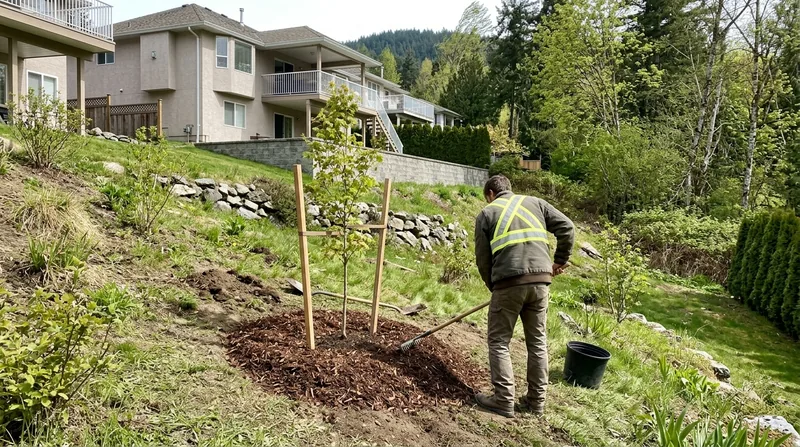




Tree planting and transplanting in Abbotsford starts with a simple question: what will this site look like in twenty years? The Abbotsford area has heavy wet clay, steep wooded ravines and lowland flats, and the wrong tree in the wrong spot costs a homeowner far more than the right one ever will. Our ISA Certified Arborists have planted and moved trees here since 2012, from the clay soils of Bradner-Mt. Lehman to the tight lots of Townline. We choose species for wet winters and dry summers, set every root flare at the correct depth, and stake only when the tree truly needs it. Whether you are replacing a windthrown western redcedar or adding a Japanese maple to a backyard in West Abbotsford, the goal is the same: a tree that establishes quickly and stays healthy. For the structural work that often comes first, see our tree pruning service.
Why planting and transplanting need a plan, not a shovel
Most failed plantings in Abbotsford fail in the first two summers, not the first week. The cause is usually the same: a root ball set too deep in clay that holds water, or a species that cannot handle three months of dry weather once the irrigation stops. A proper plan matches the tree to the soil, the drainage and the space it will occupy at maturity.
- We test drainage and soil texture before choosing a species, because western redcedar and big-leaf maple want moisture that a dry raised bed will never hold.
- We plant native and hardy stock suited to the Lower Mainland, including Douglas-fir, western hemlock and ornamental cherry.
- We set the root flare at grade and remove nursery wrap, wire baskets and burlap from the upper root ball.
- We stake only when windthrow risk is real, using flexible ties that allow the trunk to move and thicken.
- We leave a mulched ring and a watering schedule the homeowner can actually follow through the first two dry seasons.
Every planting ends with a written aftercare sheet, so the tree gets the deep watering it needs in July and August without guesswork.
Key fact: A 2.5 metre western redcedar planted in heavy clay near Bradner-Mt. Lehman needs roughly 20 litres of water per week through its first two summers. Skipping that schedule is the single most common reason a new cedar browns from the top down by August.
Municipal rules shape what can be planted and where. The City of Abbotsford may require a permit for a private tree removal, often with replacement-planting conditions attached, and the application is normally supported by an arborist report. Our arborist report service documents the existing trees and the proposed replacement so the application is complete. For provincial guidance on tree protection and nesting, see the BC government wildlife pages.
How our crews plant and transplant
Transplanting an established tree is a different job from planting a nursery sapling. It means cutting a root ball large enough to keep the tree alive, lifting it without shearing the roots, and replanting it at the same depth within hours. On the steep ravines and lowland flats across the Abbotsford area, access and soil moisture decide the method before anything else does.
- We walk the site with you and confirm the planting location, the mature canopy spread and the distance to the private service entrance and foundation.
- We check for active bird nests before any work starts, because nesting season runs through spring and early summer under provincial law.
- We prepare the planting hole at two to three times the root ball width, scarify the clay sides and amend only the backfill, never the surrounding soil.
- We lift and set the tree by the root ball, never by the trunk, and orient the best face of the canopy toward the main viewing angle.
- We water to settle the soil, build a shallow saucer, mulch to 8 centimetres and record the planting depth for the aftercare sheet.
For transplants, we schedule the lift for dormancy, move the tree with a full root ball and water it in the same day. A tree moved in leaf in July rarely survives the move, no matter how carefully it is handled.
Key fact: Moving a 3 metre ornamental cherry within a Townline yard typically takes a crew of three about four hours, including root ball preparation and replanting. The same tree lifted in late October establishes far better than one moved in June.
If a removal comes before the replanting, our stump grinding service clears the old root plate so the new tree is not planted into decaying wood. For larger properties where several trees are going in at once, see our lot clearing service for the site preparation that comes first.
Planting methods compared
The right method depends on the size of the tree, the soil and how much time you have. The table below sets out the options we use most often in Abbotsford and the surrounding municipalities.
| Method | Description | Context |
|---|---|---|
| Bare-root planting | A dormant nursery tree with no soil around the roots, planted in late fall or early spring. | Best for deciduous stock on well-drained ground; lightest and cheapest to handle. |
| Root ball planting | A field-grown tree lifted with soil intact around the roots and set into a prepared hole. | Standard for conifers and larger ornamentals; works on clay where bare-root stock would struggle. |
| On-site transplanting | An existing tree lifted from one part of the property and replanted elsewhere, with a full root ball. | Suits a tree in the way of a renovation or a new septic field; done in dormancy. |
| Container planting | A potted tree planted after the roots are teased out and the nursery mix is shaken free. | Useful for small ornamentals and tight yards where access for a root ball is limited. |
| Replacement planting after removal | A new tree planted to satisfy a municipal replacement condition after a permitted removal. | Requires documentation of species, size and location for the City of Abbotsford file. |
What you need to know before planting in Abbotsford
Planting is the easy part; the rules and the site conditions are what catch homeowners out. Here is what actually governs the work on a residential lot in Abbotsford and the neighbouring municipalities.
- The City of Abbotsford may require a permit for a private tree removal, and replacement planting is often a condition of that permit.
- Rules differ from one municipality to the next across the Abbotsford area, so we confirm the local requirement before any tree comes down.
- Active bird nests are protected under provincial law, so we check for nesting before spring and early-summer work begins.
- We keep the new tree clear of the private service entrance and respect approach distances near the wire from the pole to the house.
- A tree touching the public distribution network is referred to BC Hydro, and we never work on that network.
- We chip branches and brush on site and leave the chips for mulch or haul them away, depending on what you prefer.
All of this is confirmed in writing before the crew arrives, so there are no surprises on planting day. Our pricing page sets out how we quote planting and transplanting work, and our service areas page lists the municipalities we cover.
Species that suit the local soil and climate
Not every tree sold at a local nursery belongs in Abbotsford clay. The species below are the ones we plant most often because they handle wet winters, dry summers and the heavy soil found across the region.
- Western redcedar works as a screen or a specimen where the ground stays moist, though it needs deep watering through dry summers to avoid dieback from the top down.
- Douglas-fir suits larger properties with room for a tall second-growth tree and a deep root system.
- Western hemlock performs on the shaded slopes and ravine edges where the soil stays cool.
- Big-leaf maple is a strong shade tree for larger yards, provided it has space for a wide canopy.
- Ornamental cherry and Japanese maple bring colour to smaller lots and fit well in Townline gardens.
- Red alder and black cottonwood are useful on wet ground and lowland flats where other species drown.
We match the species to the drainage, the light and the mature size, then confirm the choice with you before ordering stock.
If you are planning a planting project or need a tree moved, call (236) 602-5164 for a free estimate. Our crews work in Abbotsford and the surrounding municipalities, and every quote is written, itemized and free of obligation. You can also reach us through our contact page.
Prices Tree Planting & Transplanting in Abbotsford — Indicative pricing
| Service | Price | Details |
|---|---|---|
| Bare-root or container tree planting | From $250 | Includes site check, planting hole preparation, staking if needed and aftercare sheet |
| Root ball planting (up to 2.5 metre tree) | From $450 | Field-grown stock set at the correct depth, mulched and watered in |
| On-site transplanting | From $650 | Existing tree lifted with a full root ball and replanted on the same property |
| Replacement planting after permitted removal | From $400 | Documented species, size and location for the municipal file |
| Site visit and written estimate | Free | In Abbotsford and the surrounding area, response within 24 hours |
Indicative prices; free, personalized estimate within 24h at (236) 602-5164.