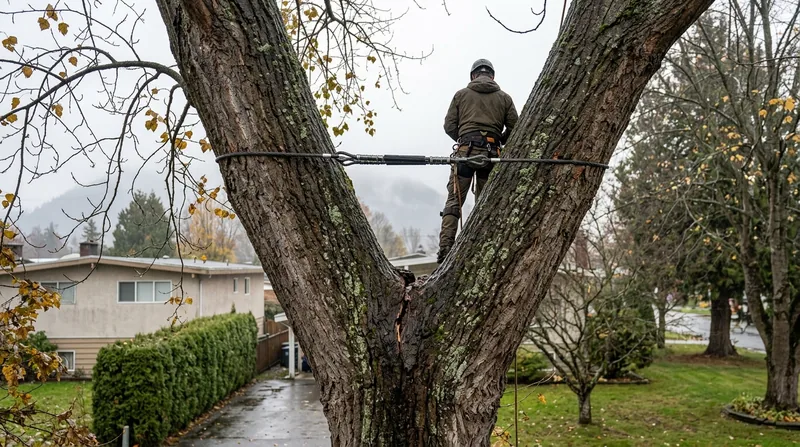




Your trees have survived decades of wind, rain and clay soil, and now one of them has a split fork or a weak limb hanging over the driveway. Tree cabling and bracing in Abbotsford gives that tree a second life: flexible steel cables and rods take the load off the weak point so the tree can keep standing through the next windstorm. We are a local, fully insured company working the Abbotsford area since 2012, with ISA Certified Arborists on staff. We inspect the tree first, confirm it is sound enough to keep, and then install hardware that reduces the risk of failure under wind and wet snow. For a tree that is already past saving, see our tree removal service.
Why a weak fork needs support before the next windstorm
Abbotsford sits on heavy wet clay, and the tall second-growth Douglas-fir and big-leaf maples left standing through subdivision often carry a narrow fork or a co-dominant stem. That is the point where decay starts and where wind torque concentrates. A cable does not heal the tree; it shares the load so the weak union is not carrying the whole crown alone. Bracing with steel rods goes further and holds a split that has already begun to open.
- We inspect the fork, the root flare and the crown to confirm the tree is a candidate for support rather than removal.
- We install flexible cables high in the crown to limit the spread of co-dominant stems.
- We brace split trunks and large limbs with steel rods where the crack is already visible.
- We document the hardware and the inspection so you have a record for your insurer.
Support hardware buys time and reduces risk, but it only works when the tree is otherwise healthy and the installation is done to arborist standards.
Key fact: A single cable installation in a mature Douglas-fir typically runs from $450 to $900 depending on height and access, and a multi-cable job in a large maple can reach $1,500. We confirm the scope on site before any hardware goes in.
The International Society of Arboriculture publishes the standards our arborists follow for cabling and bracing, and you can review them at isa-arbor.com.
How we install cables and rods in the Abbotsford area
Every job starts with a climb and a close look at the union, not with a hardware order. Our ISA Certified Arborists check for decay, cracks and included bark, then decide whether a cable, a rod or both will do the job. Installation happens in dormancy when the crown is visible and the wood is at its most predictable, though a split that appears after a storm gets braced as soon as it is safe to climb.
- We assess the tree from the ground and from within the crown, checking the fork, the roots and the surrounding targets.
- We confirm the tree is sound enough to keep and explain the limits of the hardware.
- We select the cable grade and rod size for the species and the load.
- We install the hardware at the correct height and tension, then inspect the finished work.
- We schedule a follow-up check so the cable and the tree are monitored over time.
You get a written record of what was installed and where, which matters if you ever sell the property or file a claim.
Key fact: On a Bradner-Mt. Lehman acreage, a mature big-leaf maple with a split leader over a shop roof was braced with two steel rods and one cable in a single morning. The alternative was removal at several times the cost.
If the crown also needs weight removed, we pair the hardware with structural tree pruning so the cable is not fighting an unbalanced canopy.
Cable, rod or removal: choosing the right method
Not every weak tree gets the same hardware. The right method depends on where the failure risk sits, how much decay is present and what the tree stands over. The table below shows how we match the method to the situation.
| Method | Description | Context |
|---|---|---|
| Static cable | A steel cable installed high in the crown to limit stem spread | Co-dominant stems in Douglas-fir and maple with no visible crack |
| Dynamic cable | An elastic cable that allows natural movement while sharing load | Younger or flexible trees where rigid support would be too restrictive |
| Steel rod (bracing) | A threaded rod through a split union to hold it closed | A fork or trunk that has already begun to split |
| Cable and rod combined | Rod through the split plus a cable above to share the crown load | Large maples and cedars with a split leader over a target |
| Removal | Taking the tree down when decay is too advanced to support | Hollow trunks, root failure or a target that cannot be protected |
We recommend removal only when the inspection shows the tree cannot be made safe, and we say so plainly rather than selling hardware that will not hold.
What is allowed and what we check before we start
Tree work in Abbotsford is not a free-for-all. The City of Abbotsford may require a permit for a private tree removal, often with replacement-planting conditions, and the application is normally supported by an arborist report. Cabling and bracing usually sits outside that permit process because the tree stays in place, but we confirm the situation for your address before the crew arrives. Rules differ from one municipality to the next across the Abbotsford area, so we check rather than assume.
Active bird nests are protected under provincial law, so spring and early-summer work is checked for nesting before it starts. Near private electrical service entrances, approach distances must be respected, and we never touch the public distribution network operated by BC Hydro: a tree touching the public lines is referred to BC Hydro. All cable and rod offcuts, packaging and debris leave the site with us.
If your municipality asks for a report, our arborist report service covers the tree's condition and the recommended support. For a tree that has already failed, our storm damage cleanup crew responds year-round.
When support is the wrong answer
Hardware is not a cure for a dying tree. Western redcedar dieback is common across the Lower Mainland after dry summers, and a cedar that is browning from the top down is usually losing root function, not crown structure. Cabling a declining tree just delays the inevitable and puts hardware in wood that cannot hold it. The same applies to a tree with root failure, a hollow trunk or a target that cannot be protected.
- We decline to cable a tree when the inspection shows advanced decay in the union.
- We recommend removal when the root plate has lifted or the trunk is hollow.
- We refer trees touching the public lines to BC Hydro rather than working near them.
- We explain the limits of the hardware in writing so you can plan ahead.
An honest assessment at the start saves you from paying twice for a tree that was never a candidate.
For pricing on inspection, cabling and follow-up visits, see our full pricing page or call (236) 602-5164 to book a free estimate.
Prices Tree Cabling & Bracing in Abbotsford — Indicative pricing
| Service | Price | Details |
|---|---|---|
| Cable installation (single) | From $450 | One flexible steel cable in a co-dominant fork includes inspection and written record |
| Steel rod bracing | From $550 | Threaded rod through a split union, sized to the trunk |
| Cable and rod combined | From $850 | Rod through the split plus a cable above to share the crown load |
| Multi-cable large tree | From $1,500 | Two or more cables in a mature maple or Douglas-fir, access permitting |
| Follow-up inspection | From $150 | Hardware and tree check, recommended within two years of installation |
| Free estimate | Free | On-site assessment and written scope, call (236) 602-5164 |
Indicative prices; free, personalized estimate within 24h at (236) 602-5164.