



When a tree on your property has died, is leaning over the house, or has started dropping limbs after a windstorm, tree removal in Abbotsford is the job that has to be done correctly the first time. The region's mix of tall second-growth Douglas-fir left standing through subdivision, mossy big-leaf maple, western redcedar and red alder on wet ground means many lots carry trees far larger than the yard was designed for. Add heavy wet clay, steep wooded ravines and lowland flats, and a removal that looks simple from the street can turn into a rigging job. Our crews have taken down hazardous trees across Abbotsford since 2012, working with ropes and rigging in tight backyards, on slopes and next to fences, sheds and service drops. We are a local, fully insured company with ISA Certified Arborists on staff, and we chip or haul away every piece of wood and brush before we leave. If you are still deciding between trimming and a full removal, our tree trimming service page explains where the line usually falls.
Why a hazardous tree cannot wait in Abbotsford
A dead or damaged tree does not improve with time. Western redcedar across the Lower Mainland has been browning and thinning from the top down after repeated dry summers, and a cedar that has lost its top often has a hollow or cracked trunk that is hard to see from the ground. Douglas-fir holding wet clay at the root plate can go over in a single fall windstorm, especially on ravine lots where the soil stays saturated for weeks. Leaving the tree another season raises the risk to your roof, your vehicle and anyone working in the yard.
- Dead or dying trees lose structural wood and drop limbs without warning, often on calm days.
- Leaning trees on wet clay can shift at the root plate after heavy rain and need an assessment before the next storm.
- Cracked or split trunks from earlier windthrow or storm damage rarely heal and usually worsen.
- Trees crowding a service entrance put your private electrical drop at risk and need clearance work.
- Root damage from excavation or grade changes destabilizes a tree that otherwise looks healthy.
When any of these signs is present, a free estimate from an ISA Certified Arborist is the fastest way to know whether the tree can be saved or has to come down.
Key fact: A single mature Douglas-fir in a Townline backyard can weigh several tonnes once it is sectioned. Removing one over a house typically takes a full day with a crew of three, while a small ornamental cherry in an open front yard can be down and chipped in under two hours.
For the provincial rules that govern tree care and wildlife protection, the Government of in Abbotsford and the surrounding area publishes guidance at www2.gov.bc.ca.
How our crews take a tree down
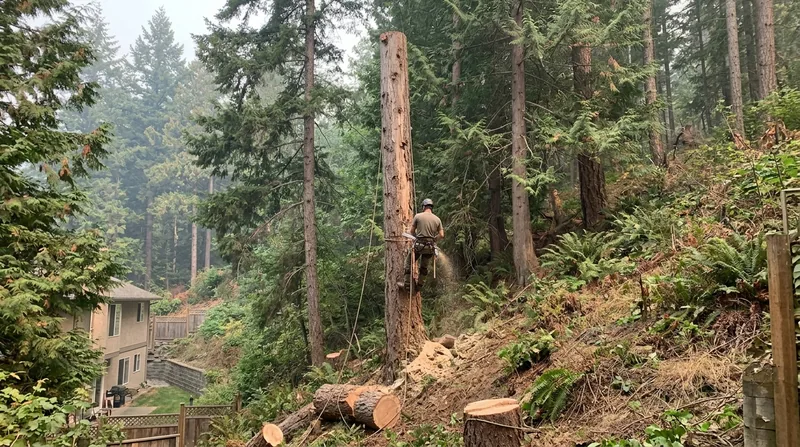
Every removal starts with a walk-around and a plan. We check the lean, the root plate, the species, the ground conditions and every obstacle within falling distance, including fences, sheds, decks and the private service entrance. From there we choose between a straight fell in an open area and a sectioned dismantle with ropes and rigging, which is the standard approach for tight backyards and slopes. The plan is explained to you before any saw starts, and the work area is marked off for the day.
- We assess the tree and the site, then confirm the approach and any permit requirement with you.
- We set rigging lines and lower sections under control when the tree cannot be felled in one piece.
- We cut the trunk flush at ground level and leave the stump ready for grinding.
- We chip brush on site and load the wood, then rake and blow the work area clean.
- We document the work with photos when the removal is part of an insurance or permit file.
Once the tree is down, most homeowners want the stump gone as well; our stump grinding service handles that in the same visit whenever the schedule allows.
Key fact: On a Bradner-Mt. Lehman acreage, a windthrown black cottonwood leaning over a barn was dismantled in sections with a rigging line anchored to a second tree. The trunk was cut flush, the brush chipped into a truck, and the barn was untouched.
Removal methods we use
The right method depends on the tree, the space around it and what sits underneath. We choose the least disruptive option that still gets the job done safely, and we tell you why we picked it.
| Method | Description | Context |
|---|---|---|
| Straight fell | The tree is cut at the base and dropped into a cleared drop zone. | Open lots, acreages, back fields with room to fall. |
| Sectional dismantle | The tree is taken down in pieces with ropes and rigging. | Tight backyards, fences, roofs and service drops nearby. |
| Crane-assisted removal | Large sections are lifted out whole when access allows. | Very tall trees where rigging alone would be slow or risky. |
| Climbing and rigging on slopes | The climber works from the tree with anchored lines on steep ground. | Ravine lots and sloped yards where equipment cannot reach. |
Whichever method we use, the crew controls every piece on the way down and cleans the site before leaving.
Permits, safety distances and debris in the Abbotsford area
Before any saw starts, we confirm what the local rules require. The City of Abbotsford may require a permit for a private tree removal, often with replacement-planting conditions, and the application is normally supported by an arborist report; our arborist report service covers that document. Rules differ from one municipality to the next across the Abbotsford area, so a job in the Township of Langley or Maple Ridge is checked against its own requirements. Active bird nests are protected under provincial law, so spring and early-summer work is checked for nesting before it starts. Near the private electrical service entrance, approach distances are respected at all times; a tree touching the public distribution network is referred to BC Hydro and is never handled by our crews. Brush is chipped on site and the wood is either hauled away or cut and stacked, depending on what you want.
For a written scope and a firm price, our pricing page explains how estimates are built, and you can book a free estimate through the contact page.
When removal is the right call, and when it is not
Removal is the last option, not the first. A tree with deadwood, a cracked branch or a crowded crown can often be kept with structural pruning in dormancy and cabling where a fork is weak. We recommend removal only when the tree is dead, when the trunk is structurally compromised, when the root plate has moved, or when the risk to people and property cannot be reduced by any other means. In Abbotsford neighbourhoods, that decision usually comes down to a cedar that has lost its top, a fir that has shifted on wet clay, or a tree crowding a service entrance. You get the reasoning in plain terms, and the choice stays yours.
If a storm has already brought a tree down, our emergency tree removal service is available year-round, with the heaviest call volume during fall and winter windstorms on saturated ground.
Prices Tree Removal in Abbotsford — Indicative pricing
| Service | Price | Details |
|---|---|---|
| Small tree removal (under 6 metres) | From $275 | Ornamental cherry, small alder or young cedar in an open yard |
| Medium tree removal (6 to 15 metres) | From $650 | Typical backyard tree, sectioned with ropes and rigging |
| Large tree removal (over 15 metres) | From $1,275 | Mature Douglas-fir or big-leaf maple, often crane-assisted |
| Hazardous or tight-access removal | Free estimate | Site assessment by an ISA Certified Arborist before quoting |
| Travel | Included | In Abbotsford and the surrounding area |
| Estimate | Free | Reply within 24 hours at (236) 602-5164 |
Indicative prices; free, personalized estimate within 24h at (236) 602-5164.