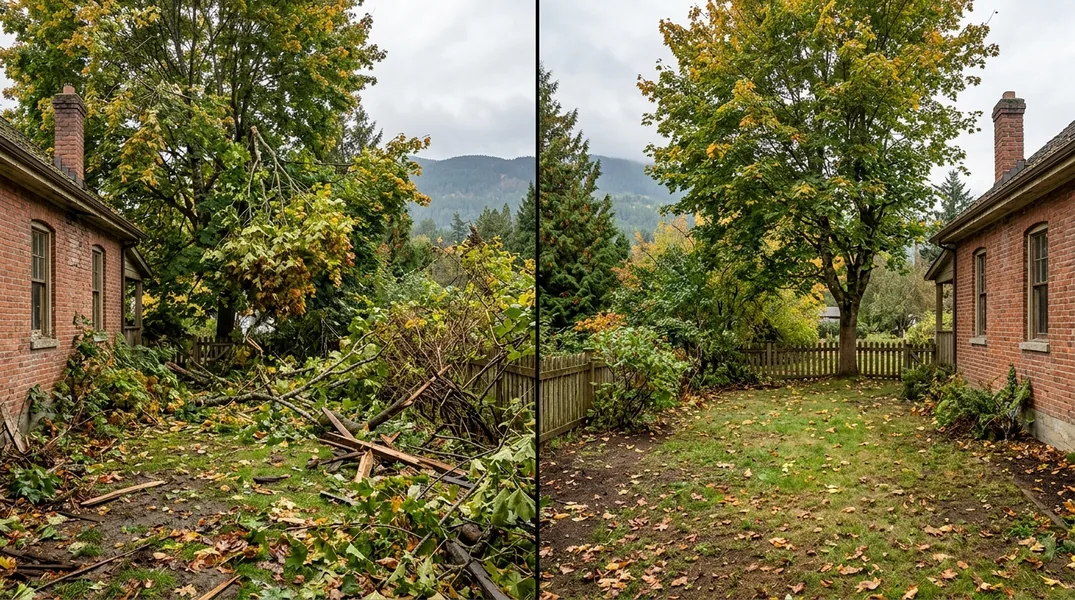
What the Heat Dome Taught Us About Trees in the Fraser Valley
The summer of 2021 left a mark on every garden and woodlot in the Fraser Valley. During the heat dome, temperatures climbed far beyond what native trees and hedges normally endure, and the damage did not disappear when the weather broke. Three years later, our crews still encounter the aftermath on properties across Abbotsford: scorched cedar hedges, thinning canopies on mature maples, and dieback that only became obvious the following spring.
What made that event so damaging was not just the peak temperature. It was the duration. Several consecutive days of extreme heat, combined with a drought that had already dried out the upper soil layer, pushed many trees past their limit. Shallow-rooted species suffered first, but even deep-rooted conifers showed stress. The lesson for homeowners is straightforward: drought-stressed trees do not recover on their own, and the decisions made in the months after a heat event often determine whether a tree survives the next decade.
At Abbotsford Tree Trimming Co., we treat drought recovery as part of routine Tree Trimming and assessment work. Understanding what happened to your trees is the first step toward helping them.
How to Recognize Drought Stress and Dieback
Drought damage rarely appears overnight. Trees close their pores and reduce growth before visible symptoms show, so by the time a homeowner notices a problem, the tree may have been struggling for weeks. The most common signs we look for are premature browning or needle drop on cedars, sunscald on the south and west-facing sides of trunks, and branch tips that fail to leaf out in spring. On big-leaf maple and Douglas-fir, drought stress often shows as smaller leaves, sparse canopy growth and deadwood in the upper crown.
Cedar hedge browning deserves special attention in this region. Western redcedar is shallow-rooted and relies on consistent moisture, so a single extreme summer can cause whole sections of a hedge to turn brown. Homeowners sometimes assume the hedge is dead and remove it prematurely. In many cases the roots are still alive and the hedge can recover with careful watering and selective Tree Pruning to remove only the dead material. An assessment before any cutting is essential, because cedars do not regrow from bare wood.
Tree dieback in the Fraser Valley is often a delayed reaction. A tree that looked fine in September may show dead leaders the following July. If you notice dieback spreading along a branch or from the top down, have it inspected before the next hot season arrives.
Watering Trees in Summer: Doing It Right
The single most effective way to help a drought-stressed tree is deep, infrequent watering. Light daily sprinkling encourages shallow roots and evaporates quickly, offering little benefit. Instead, apply water slowly at the drip line, the outer edge of the canopy where feeder roots concentrate, and let it soak down 20 to 30 centimetres (8 to 12 inches). A mature tree may need 10 to 15 litres per centimetre of trunk diameter per watering, applied every two to three weeks during dry spells.
Timing matters as much as volume. Water early in the morning or in the evening to reduce evaporation, and water the soil rather than the foliage. Newly planted trees, hedges and anything within two years of transplanting need more frequent attention because their root systems are still establishing. Established native trees are more tolerant, but even they benefit from a slow soak during a prolonged drought. If you are unsure how much water your trees are receiving, a simple soil probe pushed into the ground will tell you whether moisture is reaching the root zone.
Homeowners in West Abbotsford (Abbotsford) and other neighbourhoods on clay-heavy soils should water more slowly, since British Columbia clay absorbs water reluctantly and runoff is common. Cycle the water on and off to let it penetrate.
Mulching and Soil Care to Protect Roots
Mulching trees is one of the cheapest and most effective defences against drought. A layer of organic mulch 5 to 10 centimetres deep, spread from the trunk out to the drip line, moderates soil temperature, slows evaporation and gradually improves soil structure as it breaks down. Keep the mulch a few centimetres away from the trunk itself to avoid trapping moisture against the bark, which can invite decay.
Mulch also helps during the wet season. Healthy soil holds more water in summer, and organic matter improves drainage during the heavy rains that follow. For properties in Bradner-Mt. Lehman (Abbotsford) and other rural areas, where trees often sit in exposed, wind-swept positions, mulch combined with a windbreak planting can reduce both drought stress and windthrow risk.
If your soil is compacted from construction or heavy foot traffic, aeration around the root zone may be worth considering. Compacted soil sheds water instead of absorbing it, which leaves trees vulnerable even in a normal summer. Our crews can advise on mulching and soil care as part of a broader maintenance plan, and we are happy to provide a free estimate for the work.
When to Call an Arborist After a Heat Event
Not every stressed tree needs to be removed, but some do. Dead or dying limbs over a roof, driveway or play area are a liability, and a tree that has lost more than half its canopy may never recover its structure. An ISA Certified Arborist can assess the extent of the damage, identify which limbs are dead, and recommend whether Tree Removal is the safer option or whether the tree can be retained with corrective pruning.
If a tree does need to come down, the stump should be dealt with as well. Stump Grinding removes the remaining wood so you can replant or landscape the area, and it eliminates a common habitat for pests. Our team can handle removal, grinding and cleanup in a single visit, and we document the condition of the tree for your records.
For homeowners planning removals, note that the City of Abbotsford may require a permit for a private tree removal, and an arborist report can support that application. We can advise on what your situation requires. To book an assessment or ask about rates, call Abbotsford Tree Trimming Co. at (236) 602-5164 or request a free quote online.
Building a More Drought-Resilient Landscape
The heat dome was an extreme event, but dry summers are part of the Fraser Valley climate, and the best time to prepare is before the next one. Choosing species suited to local conditions, grouping plants by water needs, and planting in autumn so roots establish before summer all reduce long-term risk. Native species such as Douglas-fir, western hemlock and big-leaf maple are adapted to the region, though even they benefit from thoughtful siting and early care.
Hedges deserve a plan of their own. A cedar hedge trimmed regularly and watered during dry spells holds its form and density far better than one left to fend for itself. In Townline (Abbotsford) and similar neighbourhoods where hedges define property lines, proactive maintenance is worth the investment. Our crews can set up a seasonal schedule that covers hedge trimming, pruning and watering guidance, so your landscape is prepared rather than repaired.
If you are unsure where to start, a walk-through with an arborist is the most efficient way to identify which trees are thriving, which are stressed, and what work should happen this season. Contact Abbotsford Tree Trimming Co. at (236) 602-5164 to arrange a free estimate.
Looking for a professional in Abbotsford? Abbotsford Tree Trimming Co. responds quickly for all your tree trimming needs.
Get a free estimateOur services : Tree Trimming · Tree Removal · Stump Grinding